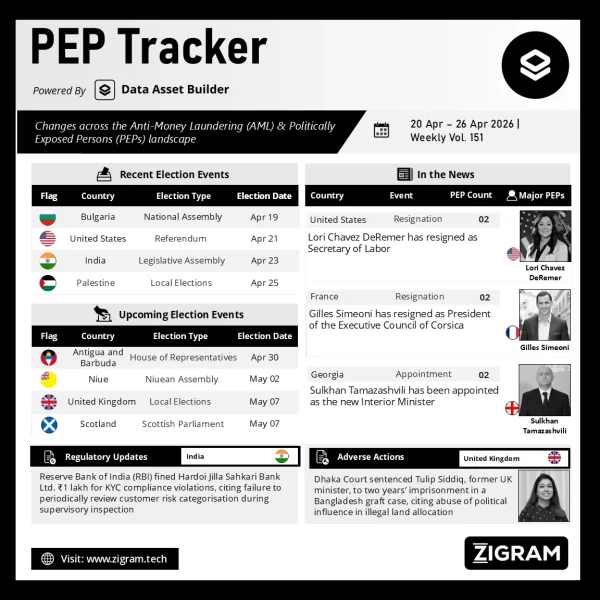
Introducing the 151st edition of the PEP Weekly Digest, covering the most recent updates across the global political and compliance landscape. Recent and upcoming elections influence the worldwide political landscape in eight nations, slated between 19 April 2026 and 7 May 2026.
8
Election Events
6
PEP Changes
1
Regulatory Actions
1
Adverse Action
What is a Politically Exposed Person (PEP)?
A Politically Exposed Person (PEP) is an individual who holds or has held a prominent public function including heads of state, government ministers, senior judiciary, and military commanders. Under FATF Recommendation 12, financial institutions must apply Enhanced Due Diligence (EDD) to PEPs. Status typically persists 12–24 months after leaving office.
Recent Election Events
| Flag | Country | Election Type | Date |
|---|---|---|---|

|
Bulgaria | National Assembly | 19 Apr 2026 |

|
United States | Referendum | 21 Apr 2026 |

|
India | Legislative Assembly | 23 Apr 2026 |

|
Palestine | Local Elections | 25 Apr 2026 |
Upcoming Election Events
| Flag | Country | Election Type | Date |
|---|---|---|---|

|
Antigua & Barbuda | House of Representatives | 30 Apr 2026 |

|
Niue | Niuean Assembly | 2 May 2026 |

|
United Kingdom | Local Elections | 7 May 2026 |

|
Scotland | Scottish Parliament | 7 May 2026 |
In the News
US Labor Secretary Lori Chavez-DeRemer Resigns Amid Misconduct Investigation
US Labor Secretary Lori Chavez-DeRemer resigned from her position amid an ongoing misconduct investigation during President Donald Trump’s second administration.
The probe included allegations that she had an affair with a subordinate, drank alcohol at work, and misused government resources for personal travel. Investigators were also examining claims that she and members of her inner circle improperly influenced grant allocations and communicated inappropriately with younger staff members.
Additional controversy surrounded allegations involving her husband, Shawn DeRemer, who was banned from Labor Department premises after female staff members accused him of sexual assault, although no charges were filed.
Following her resignation, Deputy Labor Secretary Keith Sonderling was appointed acting labor secretary. Chavez-DeRemer became the third female cabinet member to leave the administration in recent weeks, after the departures of Kristi Noem and Pam Bondi.
During her tenure, she highlighted efforts related to job growth, workforce readiness in artificial intelligence, and retirement security. Her time in office was also marked by controversy over the rollback of labor regulations, reductions in benefits for vulnerable workers, and the cancellation of international child labor initiatives.
Corsica Leader Gilles Simeoni Resigns as Executive Council President After Long Tenure
Gilles Simeoni, President of the Executive Council of Corsica, resigned from his position after holding the office for around a decade.
He announced his resignation during a session of the Corsican Assembly, formally stepping down as head of the island’s executive authority. Simeoni has been a key political figure in Corsica since 2015. His resignation follows his election as Mayor of Bastia, institutional rules prevent holding both roles simultaneously.
Following his announcement, the entire executive council also stepped down, as required by procedure. A transition process has been initiated within the Corsican Assembly to organise the election of new executive leadership.
Following her resignation, Deputy Labor Secretary Keith Sonderling was appointed acting labor secretary. Chavez-DeRemer became the third female cabinet member to leave the administration in recent weeks, after the departures of Kristi Noem and Pam Bondi.
During her tenure, she highlighted efforts related to job growth, workforce readiness in artificial intelligence, and retirement security. Her time in office was also marked by controversy over the rollback of labor regulations, reductions in benefits for vulnerable workers, and the cancellation of international child labor initiatives.
Sulkhan Tamazashvili Appointed Georgia’s Minister of Internal Affairs in Government Reshuffle
Sulkhan Tamazashvili has been appointed as Georgia’s Minister of Internal Affairs following a government reshuffle announced by Prime Minister Irakli Kobakhidze.
Before this role, Tamazashvili served as the Chairman of the Government of the Autonomous Republic of Adjara. He is also known for his long experience within Georgia’s Ministry of Internal Affairs system, where he previously held senior positions.
The reshuffle also involved changes in other key security positions. The outgoing Interior Minister, Geka Geladze, was moved to head the State Security Service. The government stated the restructuring aims to strengthen coordination within law enforcement institutions and improve administrative efficiency.
Regulatory Updates – India
Reserve Bank of India Fines Hardoi Jilla Sahkari Bank ₹1 Lakh for KYC Violations
The Reserve Bank of India (RBI) imposed a penalty of ₹1 lakh on Hardoi Jilla Sahkari Bank Ltd., Uttar Pradesh for violations related to Know Your Customer (KYC) compliance requirements.
The bank failed to ensure proper periodic review of the risk categorisation of its customer accounts within the required timeframe under KYC norms. Deficiencies were flagged during a statutory inspection conducted by the National Bank for Agriculture and Rural Development (NABARD).
Following the inspection findings, RBI issued a notice to the bank seeking clarification. After reviewing the bank’s response, RBI confirmed the violations and imposed the penalty. The central bank clarified that the penalty is based on compliance shortcomings and does not affect the validity of any customer transactions or agreements.
Adverse Actions – United Kingdom
Former UK Minister Tulip Siddiq Sentenced to Two Years in Bangladesh Graft Case
Tulip Siddiq, a British Member of Parliament and former UK government minister, was sentenced to two years in prison by a court in Bangladesh in a corruption case related to alleged illegal land allocation in Dhaka. The verdict was delivered in absentia.
The case involves allegations that Siddiq influenced her aunt, former Bangladesh Prime Minister Sheikh Hasina, to help secure a government plot of land for her family under a housing project. Prosecutors claimed the allocation was obtained through abuse of political influence and irregular procedures.
Along with Siddiq, Sheikh Hasina was sentenced to five years in prison, while Hasina’s sister Sheikh Rehana received a seven-year sentence. The court stated the accused were involved in misuse of authority linked to the Purbachal New Town project.
Tulip Siddiq has denied the allegations and criticised the proceedings. The ruling forms part of a wider corruption case involving multiple defendants.
Full Weekly Data View
- #AWEB
- #ElectionGuide
- #RobLantz
- #PrinceEdwardIsland
- #TayyipErdogan
- #AkinGurlek
- #SussanLey
- #AngusTaylor
- #BankOfMaharashtra
- #ReserveBankOfIndia
- #LeeSangMin
- #YoonSukYeol